AUTHOR: Shiva Kumar R. Mukkamalla, MD, MPH, FACP

DefinitionMicroangiopathic hemolytic anemia (MAHA) is used to describe any nonautoimmune hemolytic anemia that results in red blood cell fragmentation associated with small vessel disease. Several diseases, including thrombotic thrombocytopenic purpura (TTP), disseminated intravascular coagulation (DIC), hemolytic-uremic syndrome (HUS), atypical hemolytic-uremic syndrome (aHUS), hemolysis, elevated liver enzymes, and low platelets syndrome of pregnancy (HELLP), and malignant hypertension, are associated with MAHA.
SynonymsMAHA
Thrombotic microangiopathy (TMA)
Mechanical hemolytic anemias
Nonautoimmune hemolytic anemias
Fragmentation hemolytic anemia
| ICD-10CM CODE | | D59.4 | Other nonautoimmune hemolytic anemias |
|
Epidemiology & Demographics
- TTP: Increased incidence in women and African Americans
- Typical HUS:
- Associated with E. coli O157:H7 in 80% of cases.
- Person-person transmission is implicated.
- Children are more commonly affected than adults.
- Atypical HUS:
- Diarrhea is not a presenting feature.
- Adults are more commonly affected.
- DIC:
- Always secondary to underlying causes, including sepsis, trauma, malignancy, surgery, or obstetrical complications.
- DIC can occur in about 20% of acute leukemias.
- HELLP syndrome:
- Occurs in 10% to 20% of pregnancies with preeclampsia.
- Develops between 28 and 36 wk of gestation.
- Can also present after delivery of fetus in 30% cases.
- Malignant hypertension: MAHA complicates about 25% of malignant hypertension cases.
Physical Findings & Clinical Presentation
- Mucosal pallor
- Fatigue
- Acute onset of generalized weakness
- Jaundiced skin
- Icteric sclera
- Dark-colored urine
Etiology
| TTP | Idiopathic or familial deficiency of ADAMTS13
Acquired antibodies against ADAMTS13 | | Typical HUS | Shiga toxin-producing enterohemorrhagic E. coli O157:H7 | | Atypical HUS | Inherited disorders of comlement regulation | | DIC | Secondary to multiple causes resulting in subendothelial tissue factor exposure and subsequent activation of coagulation cascade | | HELLP syndrome | Mechanism not clearly identified, but endothelial injury from hypertension associated with preeclampsia has been implicated | | Malignant hypertension | Endothelial damage |
|

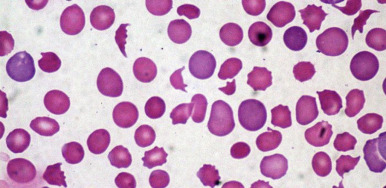
Pathognomonic findings in MAHA include anemia consistent with an intravascular hemolytic picture, including schistocytes (Fig. E1) on peripheral blood smear, elevated lactate dehydrogenase (LDH), increased indirect bilirubin, decreased serum haptoglobin, increased urinary urobilinogen, along with an elevated reticulocyte count and negative Coombs test.1,2
Figure E1 Peripheral blood smear depicting schistocytes or fragmented red blood count.
Differential Diagnosis 3
- Immune-mediated hemolysis (positive Coombs test):
- Autoimmune hemolytic anemia
- Paroxysmal nocturnal hemoglobinuria
- Cold agglutinin disease
- Infections affecting red blood count (RBC):
- Malaria
- Babesiosis
- Bartonellosis
- Hemolysis due to mechanical stress or oxidative injury:
- G6PD deficiency
- Runner’s anemia or march hemoglobinuria
- Extravascular hemolysis:
- Intrinsic RBC defects
- Liver disease
- Hypersplenism
Workup
- Peripheral blood smear showing schistocytes.
- Laboratory workup including CBC, liver function tests, LDH, haptoglobin, reticulocyte count, Coombs test, and urine analysis.
- MAHA and thrombocytopenia are sufficient to make a diagnosis of TTP or HUS; the classic “pentad” of fever, neurologic abnormalities, and renal failure is no longer necessary.
- In DIC, activated partial thromboplastin time and prothrombin time are prolonged, along with decreased fibrinogen levels and increased fibrin degradation products (including D-dimer).
- Blood pressure is greater than 180/120 mm Hg in malignant hypertension and usually associated with acute kidney injury (including hematuria and proteinuria).
- Additional specific tests:
- ADAMTS13 activity assay: Decreased activity is associated with idiopathic TTP, and ADAMTS13-directed antibodies are associated with secondary TTP.
- Stool culture for shiga toxin-producing E. coli in typical HUS.
- Although gold standard, renal biopsy is often not required for diagnosis of malignant hypertension.

If specific etiology of MAHA is not readily identified, plasma exchange therapy should be instituted immediately, in presence of thrombocytopenia and appropriate clinical picture.
- TTP:
- Emergent plasma exchange (PEX) to remove unusually large von Willebrand factor (vWF) multimers and autoantibodies directed against ADAMTS13.
- Platelet transfusions reserved only for bleeding patients. 7
- If needed, PEX can be increased from once a day to twice daily, along with concomitant use of corticosteroids.
- Patients nonresponsive to PEX can be treated with second-line rituximab with or without cyclophosphamide.
- Typical HUS: Supportive care, including hemodialysis, for severe acute kidney injury and hypertension management.
- Atypical HUS: Eculizumab has been shown to be more effective than PEX. Eculizumab is an expensive drug, and current manufacturer recommendations include lifelong use, which can be cumbersome. Ravulizumab was approved by the U.S. Food and Drug Administration (FDA) in 2018 and is dosed every 8 wk.
- DIC:
- Treatment of underlying cause corrects the coagulopathy.
- Supportive care, including hemodynamic support and antimicrobial therapy, as indicated.
- Activated protein C (APC) is FDA approved for DIC complicated by sepsis.
- HELLP syndrome:
- Emergent delivery of fetus if more than 34 wk into gestation, preferably vaginal delivery.
- If less than 34 wk gestation, corticosteroids are recommended for expediting fetal lung maturation and delivery, but not beneficial to the mother.
- Malignant hypertension:
- Control blood pressure with medical therapy as indicated.
- Care should be taken to avoid rapid lowering of systolic blood pressure, which can lead to ischemia or hyperperfusion syndrome.
Monitoring & Follow-UpSerial laboratory monitoring of CBC, LDH, and presence of schistocytes on peripheral smear is required to assess MAHA disease activity.
- TTP:
- Idiopathic TTP has a relapse rate of 18%, which can happen up to 10 yr from initial presentation.
- Serial measurements of ADAMTS13 activity may have predictive value in assessing risk of relapse.
- Typical HUS: Full recovery of renal function, baseline neurologic status, and resolution of diarrhea.
- DIC: With adequate management of underlying cause, coagulopathy associated with DIC is reversible.
- HELLP syndrome:
- MAHA, thrombocytopenia, and liver injury are resolved within 48 h after fetal delivery.
- Patients should be monitored for at least 2 days, with laboratory workup including CBC, LDH, and liver function.
- Malignant hypertension:
- Early adequate blood pressure control can reverse acute kidney injury.
- Patients can be discharged from the hospital after achieving adequate blood pressure control on an oral regimen.
Prognosis
- TTP:
- If untreated, TTP has a high mortality rate of 90%.
- With PEX, mortality rate in idiopathic TTP is 15% and up to 59% in nonidiopathic TTP.
- Typical HUS:
- Typical HUS has a mortality rate of 5%, and younger children have better prognosis compared with adults.
- Central nervous system involvement or other extrarenal manifestations portend poor outcomes.
- Atypical HUS:
- Mortality ranges between 15% and 25%.
- Adults have poor prognosis compared with children.
- At 1-yr mark, about 25% of all patients have chronic renal failure.
- DIC:
- Prognosis of DIC depends on the severity of coagulopathy and underlying condition.
- DIC has been shown to be an independent predictor of mortality in sepsis and trauma, increasing the risk of death by a factor of 1.5 to 2.
- HELLP:
- Increased risk of preeclampsia in future pregnancies.
- Recurrence of HELLP with subsequent pregnancies is about 5%.
- Malignant hypertension:
- 10-yr overall survival is approximately 50%.
- MAHA in malignant hypertension predicts an increased likelihood of need for future hemodialysis.
Referral
- Hematologist
- Nephrologist
- Neurologist
- Obstetrician
