Floaters, blurred vision, and/or flashes of light which are more common in dim illumination or with eye movement. Symptoms usually present acutely and can evolve over hours to days.
One or more discrete near-translucent or light gray vitreous opacities, one often in the shape of a ring (Weiss ring) or broken ring, suspended over the optic disc (See Figure 11.1.1).
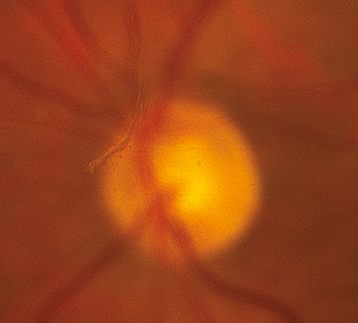
Retinal break/tear (RT), retinal detachment (RD), pigmented cells in the anterior vitreous (tobacco dust or Shafer sign), or vitreous hemorrhage (VH) may occur with or without a posterior vitreous detachment (PVD), with similar symptoms. Peripheral retinal and disc margin hemorrhages.
Approximately 10% of all patients with acute symptomatic PVD have a retinal break. The presence of pigmented cells in the anterior vitreous or VH in association with an acute PVD indicates a high probability (>70%) of a coexisting retinal break. See 11.2, Retinal Break (Tear). |
Uveitis: In vitritis, vitreous cells may be found in both the posterior and anterior vitreous, the condition may be bilateral, and the cells are not typically pigmented. Many uveitides, particularly white dot syndromes, will also present with floaters and photopsias. See 12.3, Posterior Uveitis.
Migraine: Multicolored photopsias in a repetitive zig-zag pattern that obstructs vision lasts approximately 20 minutes. A headache may or may not follow, and symptoms may be bilateral. Normal fundus examination. See 10.27, Migraine.
History: Duration of symptoms? Distinguish retinal photopsias from the visual phenomenon of migraine, which may be accompanied by new floaters. Presence and location of photopsias do not correlate with location of retinal break(s). Risk factors for retinal break (trauma, previous intraocular surgery, yttrium aluminum garnet [YAG] laser capsulotomy, high myopia, personal or family history of RT/RD)?
Complete ocular examination, including evaluation of the vitreous for pigmented cells or VH and a dilated fundus examination with indirect ophthalmoscopy and scleral depression to rule out a retinal break and detachment. Optical coherence tomography (OCT) can be helpful in confirming the presence or absence of a PVD. Pseudophakic patients may have smaller and more anterior breaks compared to phakic patients. Examine the fellow eye to assess for presence of PVD and peripheral retinal pathology. See Video: Scleral Depression Tutorial. See Video: Smartphone Video Indirect Ophthalmoscopy Guide.
Visualize the PVD at the slit lamp with a handheld lens by identifying a gray-to-white ring or broken ring suspended in the vitreous. If not visible, have the patient make rapid saccades and then look straight to float the PVD into view.
If VH obscures visualization of the retina, ultrasound (US) is indicated to identify the PVD and rule out a retinal break, RD, or other causes of VH. Inferior layering of VH may mimic a retinal break on US. See 11.13, Vitreous Hemorrhage.
No treatment is indicated for PVD unless an acute retinal break or dense VH is found; see 11.2, Retinal Break (Tear).
The patient should be given a list of RD symptoms (a significant increase in floaters or flashing lights, worsening vision, or the appearance of a persistent curtain or shadow anywhere in the field of vision) and told to return immediately if these symptoms develop. The timing of symptoms could be anywhere from days to years later.
Patients should be informed that they will also likely develop a PVD in their fellow eye, if not already present.
If no retinal break or hemorrhage is found, the patient should be scheduled for repeat examination with scleral depression in 4 to 6 weeks. There is a 2% to 5% risk of developing new retinal breaks in patients with PVD and no retinal break at presentation. There is a 1% risk of developing a new RD in eyes with acute PVD and no RD at presentation.
If no retinal break is found, but mild VH or peripheral punctate retinal hemorrhages are present (indicating increased vitreous traction), repeat examination should be performed in 1 to 2 weeks.
If no retinal break is found but significant VH or anterior pigmented vitreous cells are present, repeat examination should be performed promptly by a retina specialist because of the high likelihood of a retinal break.