Author: Bethany K. Sederdahl, MPH, MD and Anthony Sciscione, DO


Chlamydia trachomatis (CT) is a gram-negative, obligate intracellular bacterium with a unique biphasic life cycle. It is considered the leading bacterial cause of sexually transmitted infections worldwide and is also the leading cause of preventable blindness.1,2 It is composed of three biovars: Trachoma, genital tract, and lymphogranuloma venereum (LGV). These biovars are further categorized into serovars, distinguished by differences in major out membrane proteins (MOMPs), epitopes that can be detected using monoclonal antibodies.1 The trachoma biovar (serovars A-C) is associated with ocular disease, the genital tract biovar (serovars D-K) primarily with sexually transmitted infection, and the LGV biovar (serovars L1-3) with invasive urogenital or anorectal disease.1,2
| ICD-10CM CODES | |||
| A56.2 | Chlamydial infection of genitourinary tract, unspecified | ||
| A56 | Other sexually transmitted chlamydial diseases | ||
| A56.0 | Chlamydial infection of lower genitourinary tract | ||
| A56.00 | Chlamydial infection of lower genitourinary tract, unspecified | ||
| A56.01 | Chlamydial cystitis and urethritis | ||
| A56.02 | Chlamydia vulvovaginitis | ||
| A56.09 | Other chlamydial infection of lower genitourinary tract | ||
| A56.1 | Chlamydial infection of pelviperitoneum and other genitourinary organs | ||
| A56.19 | Other chlamydial genitourinary infection | ||
| A56.3 | Chlamydial infection of anus and rectum | ||
| A56.4 | Chlamydial infection of pharynx | ||
| A56.8 | Sexually transmitted chlamydial infection of other sites | ||
CT is the most prevalent bacterial cause of sexually transmitted disease in the U.S. and globally. In 2020, the WHO estimated 128.5 million new CT infections among adults aged 15 to 49 yr.3 In 2022, the CDC identified 1.65 million new CT infections, with rates of reported infection increasing by 1.8% in males and decreasing by 1.2% in females.4 About 1.8 million cases were reported in 2019.4 CT infection is often asymptomatic, and estimates of prevalence are likely lower than reality. CT is most prevalent in younger individuals, and 57.7% of new CT cases in the U.S. were among those 15 to 24 yr of age.4
The majority (70% to 80%) of CT infections in females are asymptomatic; however, untreated infections can have significant consequences. Manifestations of CT infection include cervicitis, acute urethral syndrome, endometritis, and pelvic inflammatory disease (PID).5,6
Ascending genital infection (PID) is estimated to occur in 10% to 20% of women with untreated CT and confers a risk of sepsis, tubal infertility, ectopic pregnancy, and chronic pelvic pain.7,8 Additionally, untreated CT increases an individual’s risk of acquiring HIV if exposed.8
On exam, women with CT infection may have no signs; however, purulent discharge and cervical friability (caused by inflammation of endocervical columnar epithelium) can occur. PID is a clinical diagnosis, confirmed by findings of pelvic pain with cervical motion, adnexal, or uterine tenderness on exam. A less frequent manifestation of PID is a result of ascending intraabdominal infection, perihepatitis, also referred to as Fitz-Hugh-Curtis syndrome.
In men, most infections are asymptomatic but can result in mucopurulent discharge, urethritis, prostatitis, or epididymitis. Prostatitis may present as urinary dysfunction, pain with ejaculation, and pelvic pain. Epididymitis manifests as unilateral testicular pain and swelling and in rare cases can result in infertility.9
- Sexually transmitted inclusion conjunctivitis can develop as a consequence of conjunctiva exposed to infected genital secretions. Common symptoms include blurred vision, foreign body sensation, watery discharge, and redness of the eyes. Symptoms may be mistaken for environmental allergies.10
- CT infection can also cause proctitis or infection of the rectum in men and women. This usually presents with rectal pain, discharge, or bleeding. CT infection of the throat is usually asymptomatic in both men and women and not a usual cause of pharyngitis. Aseptic, reactive arthritis is a rare, self-limiting complication of CT infection that is more common in men.5,8
- Infants born to women with untreated CT are at risk of conjunctivitis and pneumonia.8 Neonatal conjunctivitis onset is typically 5 to 12 days after birth, while a subacute pneumonia, often in the absence of fever, develops at 1 to 3 mo of age.8,9
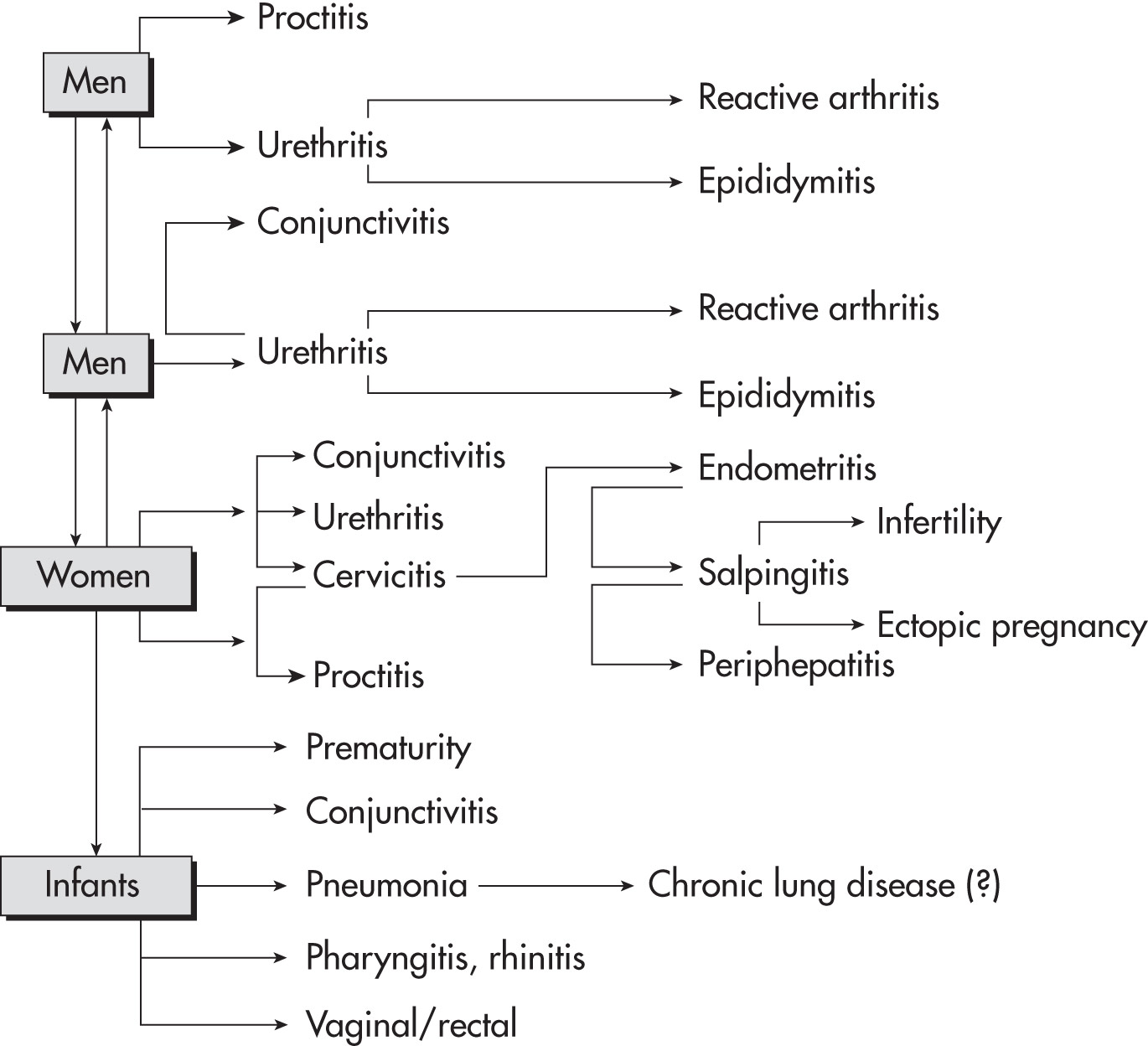
Clinical manifestations and sequelae of Chlamydia trachomatis urogenital infections and patterns of transmission are illustrated in Fig. 1. Table 1 summarizes clinical characteristics of common C. trachomatis infections.
TABLE 1 Clinical Characteristics of Common Chlamydia trachomatis Infections
| Infection | Symptoms and Signs | Presumptive Diagnosis | Definitive Diagnosis | Treatment | |
| Men | Nongonococcal urethritis | Urethral discharge, dysuria | Urethral leukocytosis; no gonococci seen | Urine or urethral NAAT | Doxycycline, 100 mg PO bid, for 7 days |
| Epididymitis | Unilateral epididymal tenderness, swelling; pain; fever, presence of NGU | Urine or urethral NAAT | Urethral leukocytosis; pyuria on urinalysis | STI likely: Ceftriaxone 500 mg (1 g for individuals weighing >150 kg) IM plus doxycycline, 100 mg PO bid, for 10 days | |
| If enteric organisms are suspected: | |||||
| Ceftriaxone, 500 mg (1 g for individuals weighing >150 kg) IM, plus levofloxacin, 500 mg bid for 10 days | |||||
| Proctitis (non-LGV) | Rectal pain, discharge and bleeding; history of receptive anal intercourse | ≥1 PMN/OIF on rectal Gram stain; no gonococci seen | Urine or urethral NAAT; rectal culture or NAAT | Ceftriaxone, 500 mg (1 g for individuals weighing >150 kg) IM, plus doxycycline, 100 mg PO bid, for 7 days | |
| Lymphogranuloma venereum proctitis | Painful, tender inguinal lymphadenopathy, fever | "Groove sign" | Urine, urethral, lymph node, or rectal NAAT; rectal or lymph node culture; LGV-specific testing if available | Doxycycline, 100 mg PO bid, for 21 days | |
| Women | Cervicitis | Mucopurulent cervical discharge; ectopy, easily induced bleeding | ≥20 PMN/OIF on cervical Gram stain | Urine or cervical NAAT | Doxycycline, 100 mg PO bid, for 7 days |
| Urethritis | Dysuria, frequency; no hematuria | Pyuria on UA; negative urine Gram stain and culture | Urine, cervical, or urethral NAAT | Doxycycline, 100 mg PO bid for 7 days | |
| Pelvic inflammatory disease | Lower abdominal pain, adnexal pain, cervical motion tenderness | Evidence of mucopurulent cervicitis | Urine or cervical NAAT | Outpatient: Ceftriaxone 500 mg IM as a single dose, plus doxycycline 100 mg PO bid for 14 days, with metronidazole, 500 mg PO bid for 14 days | |
| Adults | Conjunctivitis | Ocular pain, redness, discharge; simultaneous genital infection | Gram stain of conjunctival swab negative for bacterial pathogens; PMNs on smear | DFA or NAAT on conjunctival swab | Doxycycline, 100 mg PO bid for 7 days |
| Newborns | Conjunctivitis | Ocular pain, redness, discharge; simultaneous genital infection | Gram stain of conjunctival swab negative for bacterial pathogens; PMNs on smear | DFA or NAAT on conjunctival swab; vagina, rectum, pharynx also often positive | Erythromycin base 50 mg/kg/day, PO divided into four doses daily for 14 days; evaluate and treat parents as well |
| Pneumonia | Staccato cough, tachypnea, hyperinflation | Diffuse interstitial infiltrate, eosinophilia | Nasopharyngeal NAATs or culture; MIF serology (IgM) | Erythromycin base or ethylsuccinate 50 mg/kg/day, PO divided into four doses daily for 14 days; evaluate and treat parents as well |
bid, Twice daily; DFA, direct fluorescent antibody; IgM, immunoglobulin M; IM, intramuscular; LGV, lymphogranuloma venereum; MIF, microimmunofluorescence; MSM, men who have sex with men; NAAT, nucleic acid amplification test; NGU, nongonococcal urethritis; OIF, oil immersion field; PMN, polymorphonuclear neutrophil; PO, by mouth; STI, sexually transmitted infection; UA, urinalysis.
From Bennett JE et al: Mandell, Douglas, and Bennett’s principles and practice of infectious diseases, ed 9, Philadelphia, 2020, Elsevier.

Chlamydia trachomatis is an obligate, intracellular bacteria. At the time of exposure, CT exists in the extracellular, transmissible form called elementary body (EB). Infected epithelial cells release inflammatory mediators and chemokines that trigger an influx of leukocytes including lymphocytes, macrophage, and eventually plasma cells. Fibroblast proliferation, mediated by Th1 and Th17 cell types, results in scar tissue formation associated with tubal factor infertility.7,11 Within 6 to 8 h of entering the host cell, CT reorganizes into a reticulate body (RB) that reproduces by binary fission.5

