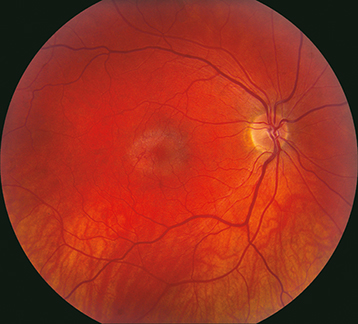
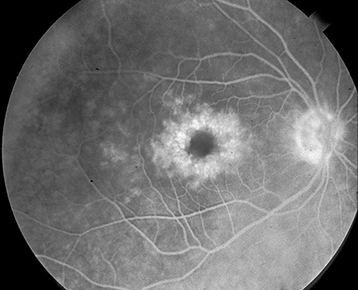
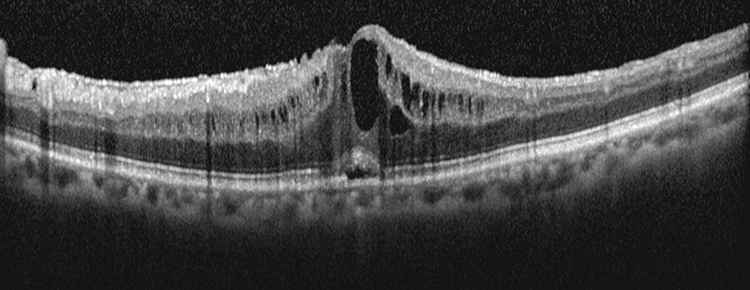
(See Figures 11.14.1 to 11.14.3.)
Irregularity and blunting of the foveal light reflex, macular thickening with or without small intraretinal cysts in the foveal region.
Vitreous cells, optic nerve swelling, and dot hemorrhages may be observed depending upon etiology of CME.
Postoperative, following any ocular surgery, including laser photocoagulation and cryotherapy. The peak incidence of post cataract extraction CME, or IrvineGass, is approximately 6 to 10 weeks; the incidence increases with cataract surgical complications including vitreous loss, vitreous to the corneoscleral wound, iris prolapse, or uveal incarceration.
Diabetic retinopathy: See 11.12, Diabetic Retinopathy.
CRVO and BRVO: See 11.8, Central Retinal Vein Occlusion and 11.9, Branch Retinal Vein Occlusion.
Uveitis: Particularly pars planitis; see 12.2, Intermediate Uveitis.
RP: See 11.28, Retinitis Pigmentosa and Inherited Chorioretinal Dystrophies.
Topical drops: Epinephrine, dipivefrin, and prostaglandin analogs, especially in patients who have undergone cataract surgery.
Retinal vasculitis: Eales disease, Behçet syndrome, sarcoidosis, necrotizing angiitis, multiple sclerosis, cytomegalovirus retinitis, others.
Retinal telangiectasias: Coats disease, idiopathic macular telangiectasia, others.
AMD: See 11.16, Nonexudative (Dry) Age-Related Macular Degeneration and 11.17, Neovascular or Exudative (Wet) Age-Related Macular Degeneration.
ERM: See 11.26, Epiretinal Membrane (Macular Pucker, Surface-Wrinkling Retinopathy, Cellophane Maculopathy).
Associated with other ocular conditions: RD, subfoveal CNV, intraocular tumors, others.
Others: Systemic HTN, collagen vascular disease, autosomal dominant CME, others.
Pseudo-CME (no leakage on IVFA): Nicotinic acid maculopathy (typically seen only with relatively high doses of nicotinic acid), taxane drugs, X-linked retinoschisis (can see leakage with ICGA), myopic foveal schisis, GoldmannFavre disease (and other NR2E3-related retinopathies), pseudohole from an ERM.
History: Recent intraocular surgery? Diabetes? Previous uveitis or ocular inflammation? Night blindness or family history of eye disease? Medications, including topical epinephrine, dipivefrin, or prostaglandin analogs?
Complete ocular examination, including gonioscopy to rule out the presence of retained lens fragments following cataract surgery and haptic malposition of implanted anterior chamber intraocular lens. Thorough peripheral fundus evaluation (scleral depression inferiorly may help to detect pars planitis). Macular examination is best performed with a slit lamp and a handheld lens.
IVFA shows early leakage of perifoveal capillaries and late macular staining, classically in a petaloid or spoke-wheel pattern. Optic nerve head leakage is sometimes observed (particularly in inflammatory conditions such as IrvineGass syndrome). Fluorescein leakage does not occur in select cases of pseudo-CME (see above).
OCT will confirm the presence of CME, quantify the degree of edema and help guide the response to therapy. OCT shows central thickening with cystic spaces and loss of foveal contour. It will also help to identify any associated or contributory vitreomacular abnormalities such as ERM or VMT.
Other diagnostic tests when indicated: Fasting blood sugar and HbA1c, ERG, others.
Treat the underlying disorder if possible. For CME related to specific etiologies (e.g., diabetes, RVO, intermediate uveitis, etc.), see specific sections.
Topical NSAID (e.g., ketorolac 0.5% q.i.d., bromfenac 0.09%, or nepafenac 0.3% daily) often in conjunction with topical steroids (e.g., prednisolone acetate 1% q.i.d.).
Discontinue topical epinephrine, dipivefrin, or prostaglandin analog drops and medications containing nicotinic acid.
Other forms of therapy are often used to treat CME depending upon etiology:
Subtenon steroid (e.g., triamcinolone 40 mg/mL, inject 0.5 to 1.0 mL).
Intravitreal steroid (e.g., triamcinolone 40 mg/mL, inject 1 to 4 mg).
Intravitreal anti-VEGF therapy (e.g., bevacizumab 1.25 mg in 0.05 mL).
Systemic steroids (e.g., prednisone 40 mg p.o. daily for 5 days and then taper over 2 weeks).
Systemic NSAIDs (e.g., indomethacin 25 mg p.o. t.i.d. for 6 weeks).
Topical or systemic carbonic anhydrase inhibitors (e.g., dorzolamide 2% t.i.d. or acetazolamide 500 mg p.o. daily starting dose) in cases of RP-associated CME.
CME with or without vitreous incarceration in a surgical wound may be improved by vitrectomy or YAG laser lysis of the vitreous strand.